A bank run, playable: how a healthy bank fails
A perfectly healthy bank, one rumour, and a queue. You queue for your coins. So does everyone. Then the bank dies.
Play Chapter IX free ▸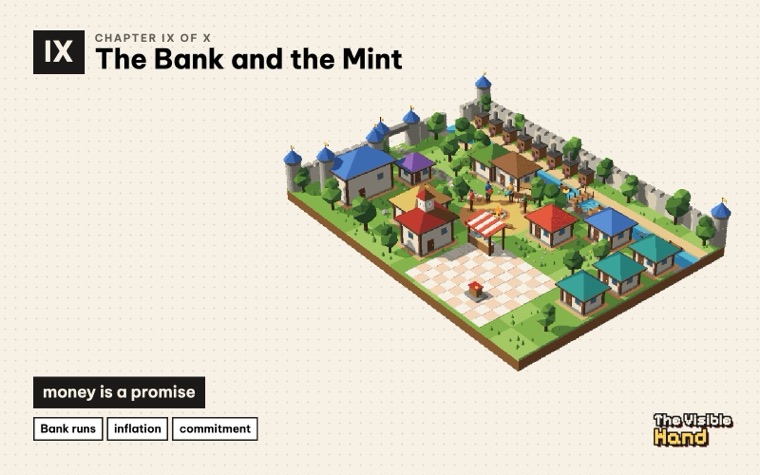
The idea
Banks lend out most of what is deposited, so no bank can pay everyone back at once. If enough people fear others will withdraw, it becomes rational for each to withdraw first, and the fear makes itself true. Diamond and Dybvig (1983) showed that a bank run can happen to a sound bank: there are two equilibria, and belief decides which one you get. Deposit insurance removes the reason to run, and if it is credible, it never has to be used. The same chapter shows why a mint that cannot print at will (a committed central bank) keeps money trusted.
What you do in the game
A healthy bank faces a rumour. Players queue for their coins, the bank fails, and then they try a deposit guarantee and a mint that can’t print at will. It takes about 5–8 minutes, runs in any browser and needs no account.
Why it matters today
Silicon Valley Bank in 2023 and Northern Rock in 2007 were modern runs; deposit guarantees and central bank independence are the lessons built into today’s system.
- If you heard your bank might fail, would you rush to withdraw? Even if it was healthy?
- The bank was healthy. Why did it fail anyway?
- The guarantee was never used. So why did it work?
Sources the game cites: Diamond & Dybvig (1983); Kydland & Prescott (1977). Teaching this? See the lesson plan for Chapter IX.