Lottery or queue? How to share out what there is not enough of
More people want a good house than there are good houses. A lottery, a queue, or “favourites first”: which is fairest, and which one makes people lie?
Play Chapter II free ▸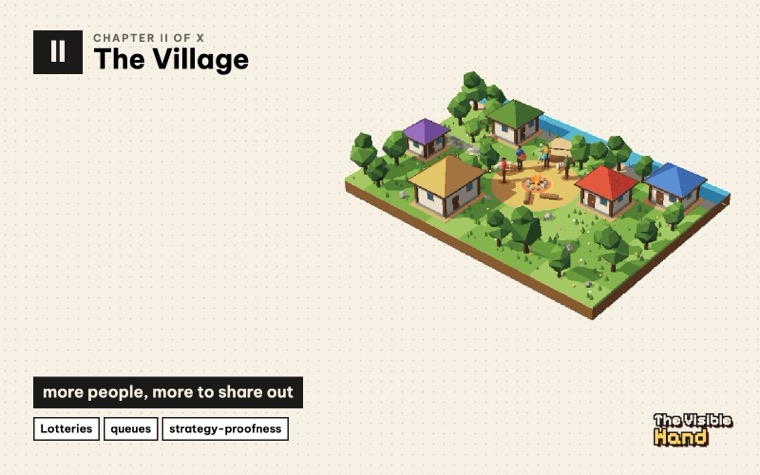
The idea
When prices are not allowed (school places, public housing, organ transplants), something else has to decide who gets what. A lottery is fair before the draw but can be wasteful after it. Taking turns in a random order (random serial dictatorship) is efficient and makes honesty safe. “Favourites first” rules sound kind but reward people who hide their true first choice. A rule is strategy-proof when telling the truth is always your best move.
What you do in the game
More families arrive than there are favourite huts. Players try three ways of handing out huts (a lottery, “favourites first” and taking turns) and see who gets what, and whether lying pays. It takes about 5–8 minutes, runs in any browser and needs no account.
Why it matters today
Many cities assign school places with algorithms built on exactly these ideas, after older “favourites first” systems pushed families to game their applications.
- There are more people than good houses. What is the fairest way to decide who gets one?
- Was the lottery fair? Fair to whom: before the draw, or after it?
- Under which rule could someone gain by lying about what they want? Why does that matter?
Sources the game cites: Shapley & Scarf (1974); Abdulkadiroğlu & Sönmez (1998). Teaching this? See the lesson plan for Chapter II.