The paradox of thrift: can everyone saving make everyone poorer?
Nothing is missing: every shop, worker and coin is still there. A rumour of hard times makes everyone save, and the whole city stops.
Play Chapter VIII free ▸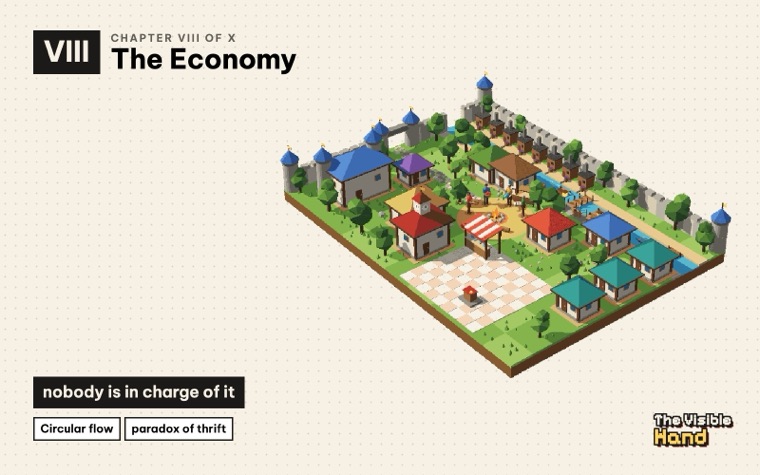
The idea
In the circular flow, one person’s spending is another person’s income. Saving is wise for one family, but if everyone cuts spending at once, everyone’s income falls, and total saving may not rise at all. This is Keynes’s paradox of thrift (1936): what is prudent for each can be harmful for all. The slump in the game is not a shortage of anything. What runs out is the belief that somebody else will spend, which is why someone who does not depend on that belief may have to spend first.
What you do in the game
Every shopkeeper sells to the others. A rumour of hard times makes each one save, and the whole city stalls, with nothing actually missing. It takes about 5–8 minutes, runs in any browser and needs no account.
Why it matters today
Debates over stimulus spending in recessions, and over austerity, are arguments about when the paradox of thrift bites.
- Saving is good for a family. Can it be bad when everyone does it at once?
- Nothing broke and nobody left. What actually ran out?
- Who could “go first” and spend to restart the city? What are the risks?
Sources the game cites: Keynes (1936); Kornai (1986). Teaching this? See the lesson plan for Chapter VIII.