The market for lemons: why honest sellers lose
If buyers cannot tell good honey from bad, they will only pay for average honey. So who keeps selling the good stuff?
Play Chapter IV free ▸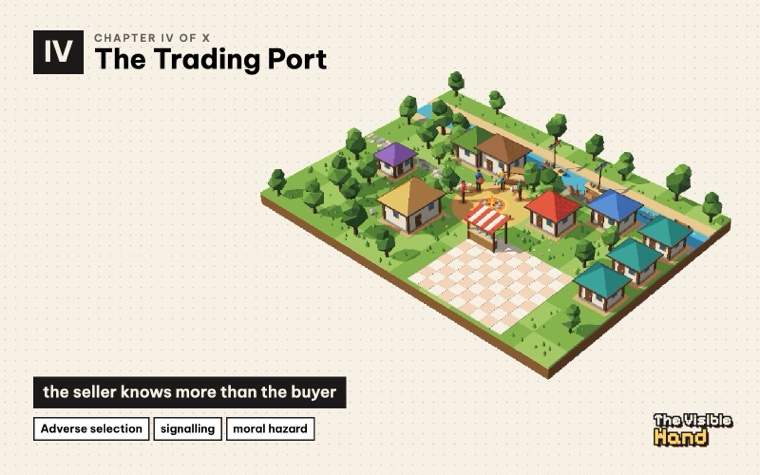
The idea
In Akerlof’s market for lemons (1970), sellers know the quality of what they sell and buyers do not. Buyers pay for average quality, so owners of good goods withdraw, average quality falls, prices fall again, and the market can unravel. This is adverse selection. The fixes are ways to make quality believable: signals that are costly to fake (Spence, 1973), warranties, reputations and inspections. Moral hazard is the cousin problem: what people do after the deal, when nobody is watching.
What you do in the game
Sellers know whether their honey is good; buyers can’t tell. Players watch good honey leave the market, then find ways for honest sellers to be believed. It takes about 5–8 minutes, runs in any browser and needs no account.
Why it matters today
Used cars, insurance, online reviews and hiring all run on solving lemons problems. Akerlof, Spence and Stiglitz shared a Nobel prize for it in 2001.
- Why might honest sellers be the first ones to leave a market?
- Why did the price fall even though some honey was excellent?
- Name a real-world signal (warranties, degrees, reviews). Why is it believable?
Sources the game cites: Akerlof (1970); Spence (1973); Holmström (1979). Teaching this? See the lesson plan for Chapter IV.