What a price cap really does: a playable fish market
A price cap to help poor families buy fish sounds kind. Play the market and watch what happens to the stalls.
Play Chapter III free ▸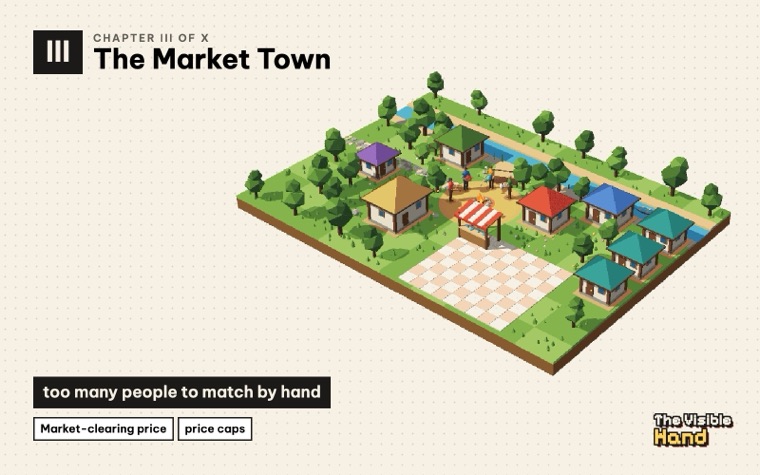
The idea
A market-clearing price is the price at which the amount people want to buy equals the amount sellers bring. Nobody calculates it. It emerges as buyers and sellers react to each other, and it quietly passes on information no single person has (Hayek, 1945). A price ceiling set below that price creates a shortage: more people want to buy at the low price, fewer want to sell, and the goods go to whoever is first or best connected instead of whoever values them most.
What you do in the game
Too many buyers and sellers to match by hand. Players find the price that clears the fish market, then see what a price cap does to the stalls. It takes about 5–8 minutes, runs in any browser and needs no account.
Why it matters today
Rent control, fuel price caps and emergency anti-gouging rules all face this trade-off between helping buyers today and keeping supply coming tomorrow.
- A price cap to help poor families buy fish: what could go wrong?
- Who gained and who lost from the cap? Who did not get any fish at all?
- Nobody told the market who wanted fish most. How did it find out?
Sources the game cites: Arrow (1951); Hayek (1945); Friedman & Stigler (1946). Teaching this? See the lesson plan for Chapter III.