For teachers

Teach ten big ideas in economics by letting students feel them

The Visible Hand is a free browser game in ten short chapters, from four families round a campfire to a central bank. Each chapter is 5–8 minutes long, stands on its own, and ends with the papers it comes from.

Try Chapter I ▸Lesson plans ↓
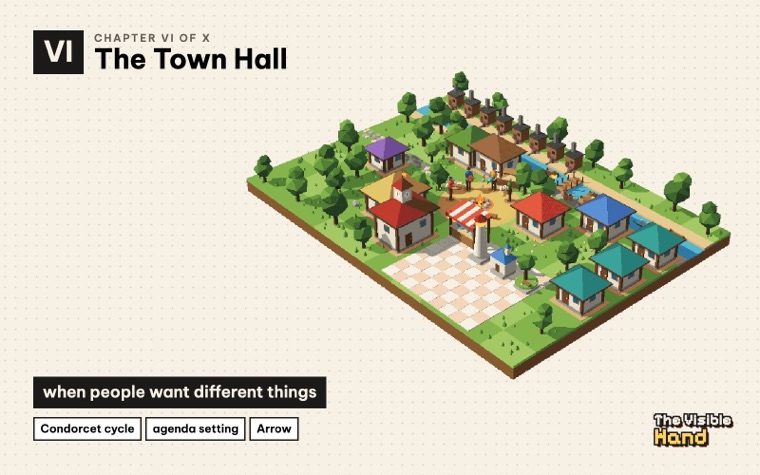
Chapter VI: The Town Hall, a vote that goes in a circle
Freeno ads, nothing to buy
No accountsstudents just open a link
Any devicelaptops, Chromebooks, phones
EN · VIEnglish and Vietnamese

Three ways to use it

Every chapter opens straight from its own link, so you can set exactly the one you need.

Lesson starter · 15 min

Ask the “Before” question, let students play one chapter, then discuss. A plan for each chapter is below.

Homework · 1 hour

Students play the whole game, then write a paragraph on the chapter that surprised them most and why.

Revision · any time

Use the chapters as a quick refresher on market failure, monetary policy or policy credibility before an exam.

Syllabus map

An approximate guide. Check it against your own specification.

ChapterBig ideaAPIB / A-level
I. The CampfireGains from trade, Pareto improvementMicro, Unit 1: Basic Economic Conceptsthe basic economic problem, gains from trade
II. The VillageAllocation without prices, lotteriesMicro, Unit 1: scarcity and allocation mechanismsrationing, non-price allocation
III. The Market TownMarket-clearing price, price capsMicro, Unit 2: Supply and Demand (price ceilings, shortages)price determination, government intervention (maximum prices)
IV. The Trading PortAsymmetric information, adverse selectionMicro, Unit 6: Market Failure and the Role of Governmentmarket failure (asymmetric information)
V. The Factory CityExternalities, Pigouvian taxMicro, Unit 6: externalities, public goods, Pigouvian taxesmarket failure (externalities, common pool resources)
VI. The Town HallCondorcet cycle, agenda setting—government failure, public choice (extension)
VII. The CapitalAuctions, bid shading—extension for strong students
VIII. The EconomyCircular flow, aggregate demandMacro, Unit 1 (circular flow) and Unit 3: National Income and Price Determinationcircular flow, aggregate demand, the multiplier
IX. The Bank and the MintBank runs, deposit insuranceMacro, Unit 4: Financial Sector (banks, money creation, central banks)monetary policy, the role of banks, financial crises
X. The HandRules vs discretion, credibilityMacro, Unit 5: Long-Run Consequences of Stabilization Policiesgovernment failure, policy credibility, central bank independence

Chapter by chapter

Each plan takes about 15 minutes: one question before, one chapter, two questions after. Print this page for a clean handout without images.

I
Chapter I of X · about 5–8 minutes

The Campfire

Gains from trade · Pareto improvement · Pareto efficiency
Chapter I: The Campfire

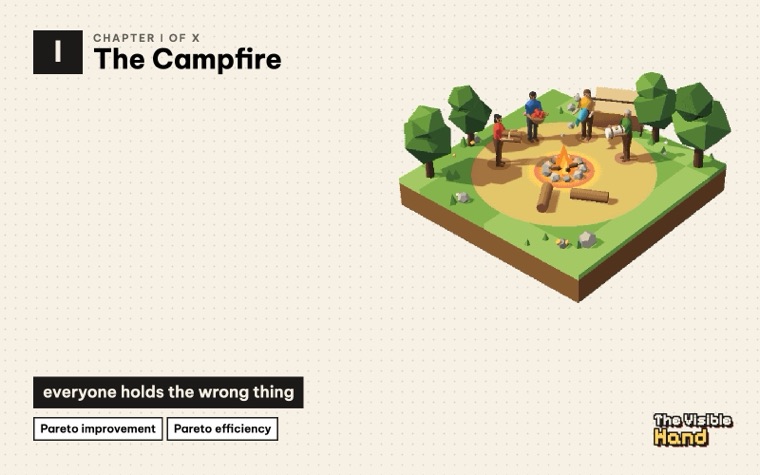
Four families each hold something another family wants more. Players arrange swaps until nobody can be made better off without making someone worse off.

Where it fits

  • AP Micro, Unit 1: Basic Economic Concepts
  • IB / A-level: the basic economic problem, gains from trade
  • Intro university: efficiency, the Edgeworth box
Open Chapter I ▸
Before 2 min

Ask: “If nobody makes anything new, can everyone still end up better off?” Take a quick show of hands.

Play 5–8 min

Students play alone or in pairs. The chapter ends with a short summary and the sources.

Discuss 5 min
  1. Which swap helped the most, and why did both sides agree to it?
  2. The final allocation is efficient. Is it also fair? Can something be one without the other?

Sources cited in the game: Pareto (1906); Edgeworth (1881) · Background reading for students
II
Chapter II of X · about 5–8 minutes

The Village

Allocation without prices · lotteries · queues · strategy-proofness
Chapter II: The Village

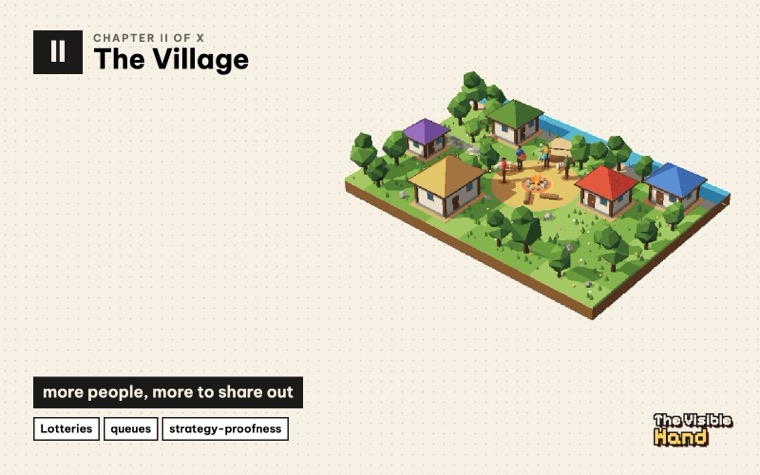
More families arrive than there are favourite huts. Players try three ways of handing out huts (a lottery, “favourites first” and taking turns) and see who gets what, and whether lying pays.

Where it fits

  • AP Micro, Unit 1: scarcity and allocation mechanisms
  • IB / A-level: rationing, non-price allocation
  • Intro university: matching and market design
Open Chapter II ▸
Before 2 min

Ask: “There are more people than good houses. What is the fairest way to decide who gets one?” Take a quick show of hands.

Play 5–8 min

Students play alone or in pairs. The chapter ends with a short summary and the sources.

Discuss 5 min
  1. Was the lottery fair? Fair to whom: before the draw, or after it?
  2. Under which rule could someone gain by lying about what they want? Why does that matter?

Sources cited in the game: Shapley & Scarf (1974); Abdulkadiroğlu & Sönmez (1998) · Background reading for students

III
Chapter III of X · about 5–8 minutes

The Market Town

Market-clearing price · price caps · dispersed knowledge
Chapter III: The Market Town

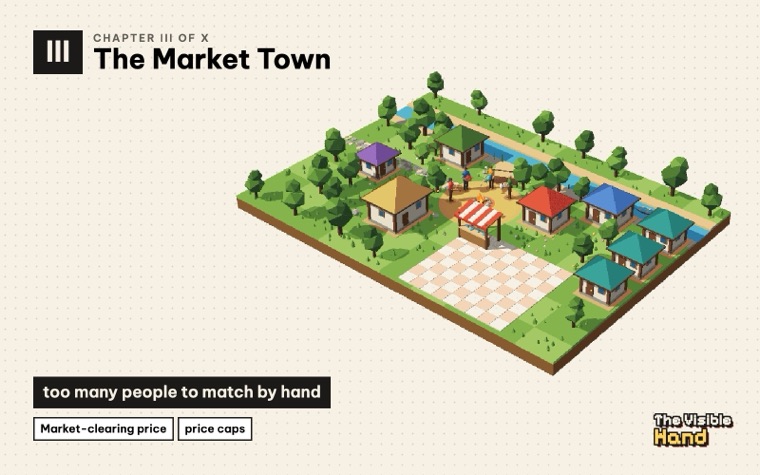
Too many buyers and sellers to match by hand. Players find the price that clears the fish market, then see what a price cap does to the stalls.

Where it fits

  • AP Micro, Unit 2: Supply and Demand (price ceilings, shortages)
  • IB / A-level: price determination, government intervention (maximum prices)
  • Intro university: welfare theorems, Hayek on knowledge
Open Chapter III ▸
Before 2 min

Ask: “A price cap to help poor families buy fish: what could go wrong?” Take a quick show of hands.

Play 5–8 min

Students play alone or in pairs. The chapter ends with a short summary and the sources.

Discuss 5 min
  1. Who gained and who lost from the cap? Who did not get any fish at all?
  2. Nobody told the market who wanted fish most. How did it find out?

Sources cited in the game: Arrow (1951); Hayek (1945); Friedman & Stigler (1946) · Background reading for students

IV
Chapter IV of X · about 5–8 minutes

The Trading Port

Asymmetric information · adverse selection · signalling · moral hazard
Chapter IV: The Trading Port

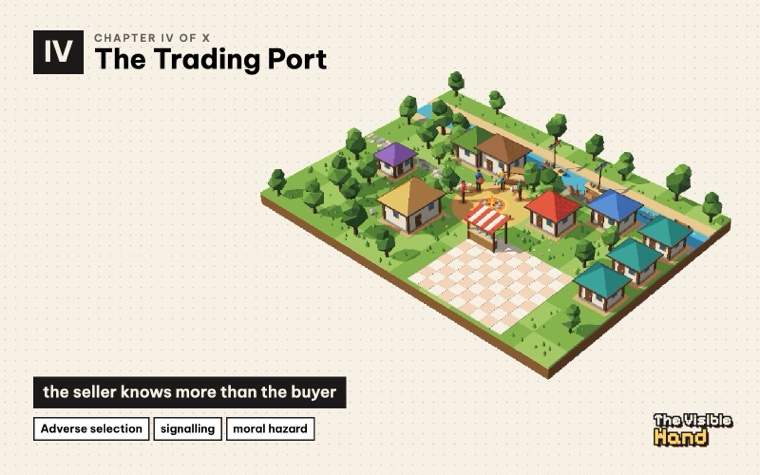
Sellers know whether their honey is good; buyers can’t tell. Players watch good honey leave the market, then find ways for honest sellers to be believed.

Where it fits

  • AP Micro, Unit 6: Market Failure and the Role of Government
  • IB / A-level: market failure (asymmetric information)
  • Intro university: Akerlof’s lemons, signalling
Open Chapter IV ▸
Before 2 min

Ask: “Why might honest sellers be the first ones to leave a market?” Take a quick show of hands.

Play 5–8 min

Students play alone or in pairs. The chapter ends with a short summary and the sources.

Discuss 5 min
  1. Why did the price fall even though some honey was excellent?
  2. Name a real-world signal (warranties, degrees, reviews). Why is it believable?

Sources cited in the game: Akerlof (1970); Spence (1973); Holmström (1979) · Background reading for students

V
Chapter V of X · about 5–8 minutes

The Factory City

Externalities · Pigouvian tax · public goods · the commons
Chapter V: The Factory City

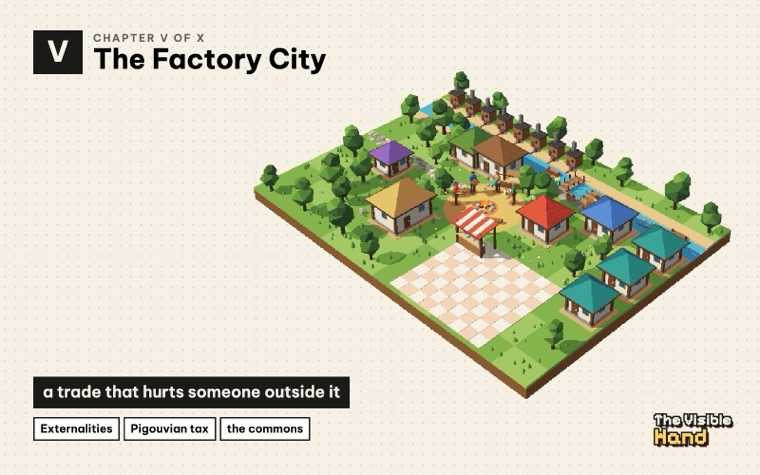
Eight dye works upstream, fishers downstream. Nobody is evil, yet the river dies. Players try charging each works for the harm it does.

Where it fits

  • AP Micro, Unit 6: externalities, public goods, Pigouvian taxes
  • IB / A-level: market failure (externalities, common pool resources)
  • Intro university: Coase vs Pigou
Open Chapter V ▸
Before 2 min

Ask: “Nobody wanted to poison the river. So who is to blame?” Take a quick show of hands.

Play 5–8 min

Students play alone or in pairs. The chapter ends with a short summary and the sources.

Discuss 5 min
  1. After the charge, which dye works kept running, and why those ones?
  2. Coase says the two sides could just bargain. Why might that fail here?

Sources cited in the game: Pigou (1920); Coase (1960); Samuelson (1954); Hardin (1968) · Background reading for students

VI
Chapter VI of X · about 5–8 minutes

The Town Hall

Condorcet cycle · agenda setting · Arrow’s impossibility theorem
Chapter VI: The Town Hall

Nine voters, three projects, voting two at a time. Change only the order of the votes and a different project wins.

Where it fits

  • Civics / government: voting systems and agenda power
  • IB / A-level: government failure, public choice (extension)
  • Intro university: social choice, Arrow, Gibbard
Open Chapter VI ▸
Before 2 min

Ask: “If everyone votes honestly, does the majority always pick the same winner?” Take a quick show of hands.

Play 5–8 min

Students play alone or in pairs. The chapter ends with a short summary and the sources.

Discuss 5 min
  1. Nobody changed their mind. Why did the winner change?
  2. Who has the real power in a committee: the voters, or whoever sets the agenda?

Careful wording for class: no ranked voting rule meets every fairness condition at once (Arrow, 1951). That is not the same as “democracy can’t be fair”.

Sources cited in the game: Arrow (1951); Gibbard (1973) · Background reading for students

VII
Chapter VII of X · about 5–8 minutes

The Capital

Auctions · bid shading · mechanism design
Chapter VII: The Capital

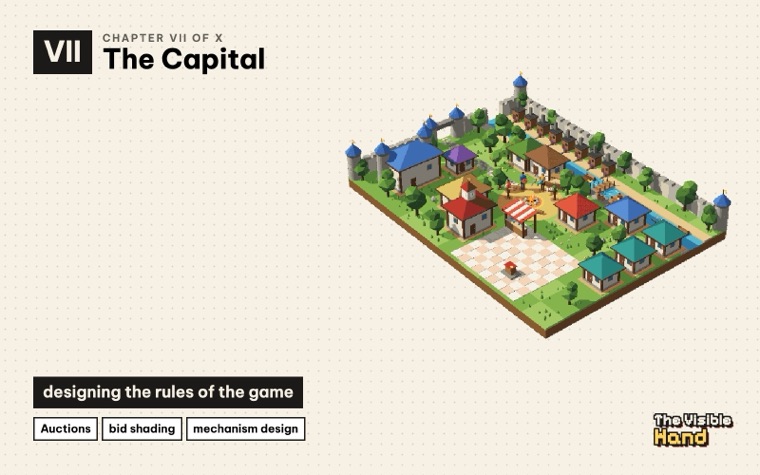
One plot is left on the capital’s square and five people want it. Asking them gets nowhere, so players bid in a pay-your-bid auction, then a second-price auction where telling the truth is the best move.

Where it fits

  • Beyond most school syllabuses: game theory and market design
  • IB / A-level: extension for strong students
  • Intro university: Vickrey auctions, mechanism design
Open Chapter VII ▸
Before 2 min

Ask: “Why might telling the truth lose you an auction?” Take a quick show of hands.

Play 5–8 min

Students play alone or in pairs. The chapter ends with a short summary and the sources.

Discuss 5 min
  1. In the second-price auction, why can’t you gain by lying?
  2. Where do real auctions use rules like this (online ads, spectrum, eBay)?

Sources cited in the game: Vickrey (1961); Myerson (1981) · Background reading for students
VIII
Chapter VIII of X · about 5–8 minutes

The Economy

Circular flow · aggregate demand · paradox of thrift
Chapter VIII: The Economy

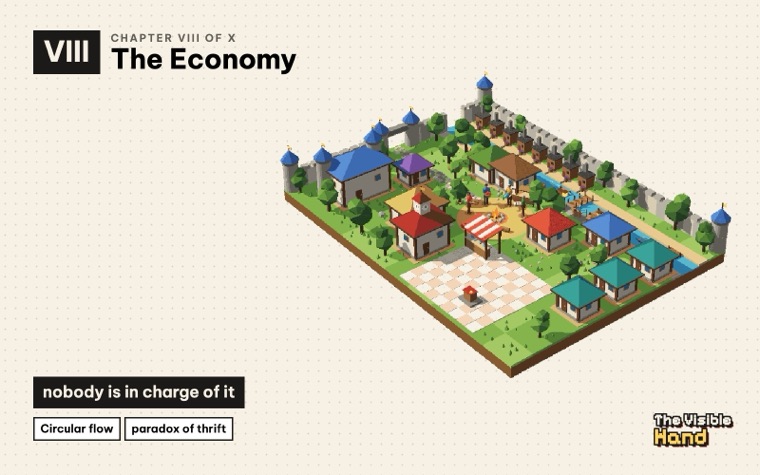
Every shopkeeper sells to the others. A rumour of hard times makes each one save, and the whole city stalls, with nothing actually missing.

Where it fits

  • AP Macro, Unit 1 (circular flow) and Unit 3: National Income and Price Determination
  • IB / A-level: circular flow, aggregate demand, the multiplier
  • Intro university: Keynes, the paradox of thrift
Open Chapter VIII ▸
Before 2 min

Ask: “Saving is good for a family. Can it be bad when everyone does it at once?” Take a quick show of hands.

Play 5–8 min

Students play alone or in pairs. The chapter ends with a short summary and the sources.

Discuss 5 min
  1. Nothing broke and nobody left. What actually ran out?
  2. Who could “go first” and spend to restart the city? What are the risks?

Sources cited in the game: Keynes (1936); Kornai (1986) · Background reading for students
IX
Chapter IX of X · about 5–8 minutes

The Bank and the Mint

Bank runs · deposit insurance · inflation · central bank commitment
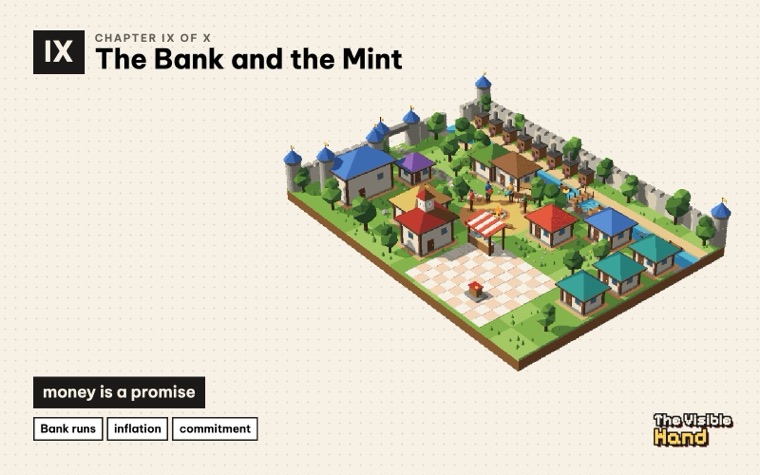
Chapter IX: The Bank and the Mint

A healthy bank faces a rumour. Players queue for their coins, the bank fails, and then they try a deposit guarantee and a mint that can’t print at will.

Where it fits

  • AP Macro, Unit 4: Financial Sector (banks, money creation, central banks)
  • IB / A-level: monetary policy, the role of banks, financial crises
  • Intro university: Diamond–Dybvig, time inconsistency
Open Chapter IX ▸
Before 2 min

Ask: “If you heard your bank might fail, would you rush to withdraw? Even if it was healthy?” Take a quick show of hands.

Play 5–8 min

Students play alone or in pairs. The chapter ends with a short summary and the sources.

Discuss 5 min
  1. The bank was healthy. Why did it fail anyway?
  2. The guarantee was never used. So why did it work?

Sources cited in the game: Diamond & Dybvig (1983); Kydland & Prescott (1977) · Background reading for students
X
Chapter X of X · about 5–8 minutes

The Hand

Rules vs discretion · credibility · Lucas critique
Chapter X: The Hand

Players govern the whole city, which runs by itself. Trouble arrives (a bank wobbles, trade stops), and people ask for exceptions. Granting one wins gratitude, and teaches everyone else that the rules can be bargained.

Where it fits

  • AP Macro, Unit 5: Long-Run Consequences of Stabilization Policies
  • IB / A-level: government failure, policy credibility, central bank independence
  • Intro university: Kydland & Prescott, the Lucas critique
Open Chapter X ▸
Before 2 min

Ask: “A friend asks you to bend a rule just once. Is that ever the right call for a government?” Take a quick show of hands.

Play 5–8 min

Students play alone or in pairs. The chapter ends with a short summary and the sources.

Discuss 5 min
  1. Each exception looked reasonable. Why did the city end up worse off?
  2. Why do many countries make their central banks independent of politicians?

Sources cited in the game: Kydland & Prescott (1977); Lucas (1976); Nordhaus (1975) · Background reading for students
Questions teachers ask

Do students need to sign up?

No. There are no accounts and no logins. Students open the link and play.

What data does it collect?

No cookies and no personal data. It counts anonymous events (for example, “Chapter III finished”) to improve the game, honours “Do Not Track”, and can be switched off in the About page.

Is it biased?

It shows markets working and failing, and governments helping and overreaching. The conclusions are the author’s reading of the cited research, and the About page says so. Disagreeing with it makes a good class discussion.

Will it run on school computers?

It needs a modern browser with WebGL (Chrome, Edge, Safari, Firefox). Nothing is installed. On older machines, open one chapter at a time using the links above.