The Condorcet paradox: a fair vote that can pick whoever you want
Nine voters, three projects, voting two at a time. Change only the order of the votes and a different project wins. Nobody changes their mind.
Play Chapter VI free ▸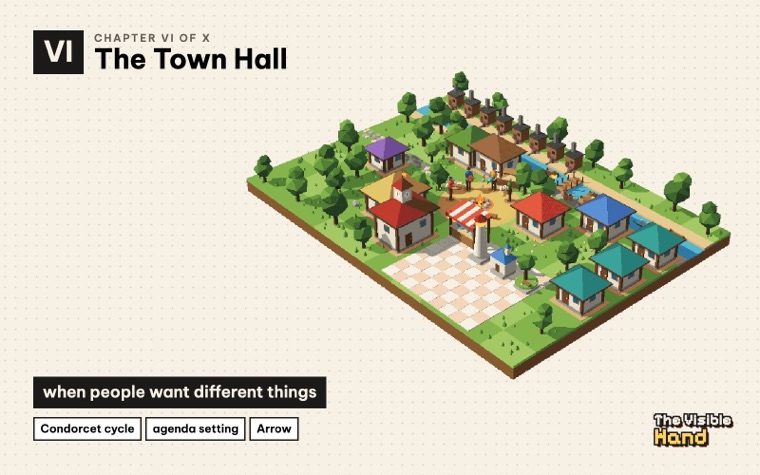
The idea
Condorcet noticed in 1785 that majorities can go in a circle: most people prefer A to B, most prefer B to C, and yet most prefer C to A. When that happens, the result of a series of pairwise votes depends on the agenda, so whoever sets the order picks the winner. Arrow (1951) proved something deeper: with three or more options, no ranked voting rule meets every reasonable fairness condition at once. Gibbard (1973) showed that every such rule rewards some voters for voting strategically.
Careful: Arrow’s theorem is about ranked voting rules. It does not mean “democracy can’t be fair”. It means every rule makes a trade-off, and someone chooses which one.
What you do in the game
Nine voters, three projects, voting two at a time. Change only the order of the votes and a different project wins. It takes about 5–8 minutes, runs in any browser and needs no account.
Why it matters today
Committee agendas, primary systems and the debates over ranked-choice, approval and score voting all live inside this result.
- If everyone votes honestly, does the majority always pick the same winner?
- Nobody changed their mind. Why did the winner change?
- Who has the real power in a committee: the voters, or whoever sets the agenda?
Sources the game cites: Arrow (1951); Gibbard (1973). Teaching this? See the lesson plan for Chapter VI.