Pareto improvement, explained by playing it
Can everyone end up better off without anyone making anything new? Yes, if things are in the wrong hands. That is a Pareto improvement.
Play Chapter I free ▸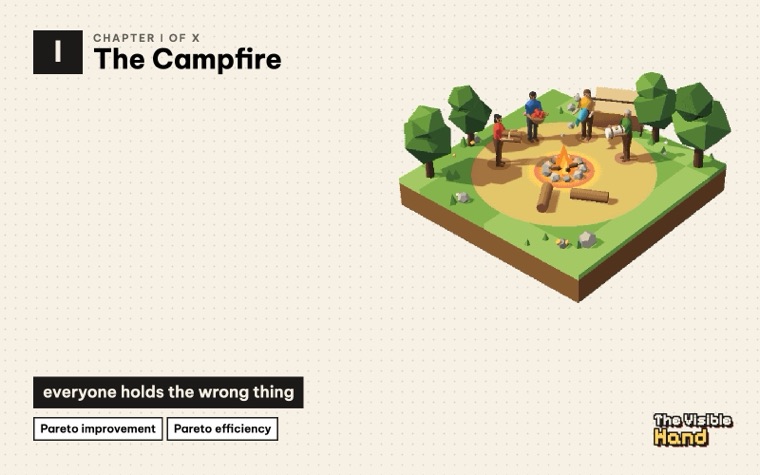
The idea
A change is a Pareto improvement if it makes at least one person better off and nobody worse off. An allocation is Pareto efficient when no such change is left. The surprise is how much can be gained just by moving what already exists: a swap that both sides choose freely helps both, or they would not agree to it. The catch is that efficiency says nothing about fairness. Giving everything to one person can be Pareto efficient too.
What you do in the game
Four families each hold something another family wants more. Players arrange swaps until nobody can be made better off without making someone worse off. It takes about 5–8 minutes, runs in any browser and needs no account.
Why it matters today
Trade, second-hand markets and kidney exchanges all create value by moving things to people who value them more. Arguments about “efficient but unfair” outcomes are arguments about where Pareto efficiency stops being enough.
- If nobody makes anything new, can everyone still end up better off?
- Which swap helped the most, and why did both sides agree to it?
- The final allocation is efficient. Is it also fair? Can something be one without the other?
Sources the game cites: Pareto (1906); Edgeworth (1881). Teaching this? See the lesson plan for Chapter I.